Monday, February 24, 2014

A Case for Salt

And...I am back!!! Although I'd like to say that I was away in a long tropical sojourn at an exotic location, I've physically been experiencing every single snow storm on the East Coast. I've seen it go from picturesque to gross during these impossibly busy months, full of work, projects, hopes and snow days. Overall, I'm thankful, and thrilled to be writing an new entry in the blog again, and starting to see daffodils being sold at the neighborhood bodegas, which every year gives me hope for the spring to arrive.

As you've probably noticed already, I love finding new food items and trends-- especially healthful ones. And although this one is definitely not new--actually it may have been the first culinary step ever taken by the human race-- it's worth to write about. 

I'm talking about salt, which we usually give for granted, but is actually one of the most fascinating food topics. Since early history, this mineral crystals have given origin to conquests, many superstitions (some people refuse to pass the salt from hand to hand, or they toss a pinch of salt over their left shoulder to get rid of bad luck, especially if they've spilled salt!), and to everyone's favorite word: "salary." And we all know that everything in life is easier to assimilate if we "take it with a grain of salt."  But before I lose you more in food idioms, let's go back to the trend: from incredible boutique businesses, such as The Medow in NYC and Portland; to the isles of Costco, the mainstream consumption temple; salts of every color, flake size and bouquet are adorning the shelves. I was recently at Kalustyan's (if you're in the NYC area and consider yourself a food enthusiast of any sort, and you've never stepped a foot inside this food import store, it's definitely worth a visit), and was shocked to see bags and bags of black, gray, pink, brown, pulverized, flaked, smoked, infused and block-shaped salts from France, England, Pakistan, Hawaii... all with lovely foreign names full of apostrophes and squiggly lines above and below the letters. It's not that I hadn't seen the varieties before, but the amounts did impress me: the shelves were covered from floor to ceiling. 

So...are we all into fancy salts? Is it just snobbery or the coolest thing ever?

I know what you might be thinking...."HELLO! high blood pressure..., heart attack..." And yes, there's definitely that, as we've been told over and over about the dangers of an excessive salt consumption. So why am I writing about it here a "healthy" blog, then?

Let's start with Dr. David Brownstein, who argues in his book Salt: The Way to Health, that the first mistake is that "nobody makes a distinction between unrefined and refined salt. They 'lump' all salt together as a bad substance." He states that, "refined salt has had its minerals removed and has been bleached to give it the white appearance that we are accustomed to seeing with salt. It is the fine, white salt that is available at almost any restaurant or grocery store." It's what we know as table salt, and it's "been bleached and exposed to many toxic chemicals in order to get it to its final product. It has aluminum, ferrocyanide, and bleach in it." He believes that "this refining process has made it a toxic, devitalized substance that needs to be avoided." On the other hand, he continues, "unrefined salt has not been put through a harsh chemical process. It contains the natural minerals that were originally part of the product." That's why salts come in different colors, as their mineral content gives them a distinct hue that varies depending on the source where the salt was obtained, either the sea or deep in the Earth. "It is the minerals in unrefined salt that provide all the benefits of this product. The minerals supply the body with over 80 trace elements [magnesium being one of them] needed to maintain and sustain health," he affirms. Unrefined salt has a much lower content of sodium chloride (about 84%, sodium still being a vital electrolyte), while table salt has almost 98%. All those extra minerals alkalize the pH and lower blood pressure, which is exactly the opposite of what table salt does. Interestingly enough, sometimes, when we experience intense salty food cravings, it's our body trying to communicate to us a mineral deficiency in it...

Another issue with refined salt that has been brought up is that the anti-clumping agents added to it to increase its shelf life (which keep salt from absorbing moisture), also interfere with the regulation of hydration in our own bodies when we consume table salt.Our bodies end up retaining water to protect themselves, and our cells release water to help dilute, neutralize, and break down the salt. This loss of water dehydrates and weakens the cells.

It's basically another clear example of refined, overprocessed food, that ends up--just like flour and sugar--looking white, pure, clean and trustworthy, but deprived of nutrients...

Am I suggesting an unrefined salt fest? 

Not really. Moderation is always key, but the QUALITY of our food, even of our salt, should also be a priority (trust me! Fast food restaurants don't add Celtic salt to their French fries!!!). And...good quality salt is the most basic way of turning what we eat from blah... to bliss!  A well seasoned salad can convert anyone into a veggie fan, while if there's no flavor balance nor anything brightening the ingredients, blandness will be unavoidable. 
Oversalting spoils our taste buds, it makes us build up our need for salt and perhaps affects our health, but not salting at all, spoils our appetites!  Did you know that recent findings have suggested that there is no actual benefit to sodium restriction when it comes to preventing heart disease or death? For references, click here and here. 


Salt is the most essential seasoning and flavor enhancer, and it's also a natural preservative, quite useful in controlling fermentation, as it inhibits the growth of yeast.  But how do we take all that to the next level, turning the simple act of salting a food (of course, with unrefined salt!) into an art?

I asked Alexandra Joseph Rabbani, Executive Chef of Salt of the Earth Bakery to give me a hand with that task. Her company's treats are luscious, rich, sweet (and almost all chocolatey), artisanal concoctions finished with hand picked salts (I'm partial to THE MAYAN brownie...), so what better expert to learn from?
Here's what she taught me, and I'm sure you'll enjoy it as well:

Q: How you decide the right pairing of salt and other flavors? What factors do you take into consideration?

A: There are many factors that play into creating the perfect salty-sweet match. After we create a new baked product, we bring it to one of several "selmelliers" (salt experts) with whom we work to find the ideal pairing. All factors are considered. Most important, of course, is the flavor profile. We always want the salt to shine, but the more important goal is to have the salt accentuate and elevate the other flavors. We don't take [the salt's] place of origin into consideration, but have struck gold several times matching salts and ingredients hailing from the same region. Texture and mouth feel are obviously a very important part of any eating experience, and the unexpected crunch or snap that salt can add to our products is always a welcome surprise.

Q: How do you balance the right amount of salt to bring out the flavors in dessert without over salting?
A: We always make a distinction between "salty" and "saltED". Every one of our products is hand-salted and we are pretty obsessive. We encourage an environment wherein we drive each other crazy about checking salt levels. 
Q:  What are your favorite kinds of salt and why?
A: The "Official Rabbani Family Salt" is definitely Sel Gris de Guerande. It is outstanding on roasted chicken and vegetables. We have large bags of it on our kitchen counter at all times. For my birthday dinner, my husband made me some amazing dry-aged steak and finished it with a sprinkle of the Sel Gris. My mouth still waters when I think of it.  
Q: What do you look for when choosing salts?
A: For me, it is all about bringing out the right flavors in your food. Different salts have different flavor profiles, from clean to briny to minerally to astringent, and you need find the right salt for the job.  
Q: Do you use different kinds of salt for cooking, baking and finishing a product, or do you combine them?

A: While finishing salts may have great flavors, there are a lot of reasons not to use them in your batter. First and foremost, they can get expensive. Second, there's no need to use a flake salt in your pasta e fagiole, because no one will know that was ever a flake once it has dissolved. Here are my general guidelines: 
  • Baking: Fine grained, non-iodized sea salt. I like the Kirkland brand best (available at Costco)
  • General Cooking: Kosher Sea Salt. Alessi makes one, and several are available via SaltWorks.us. 
  • Finishing: Sel Gris de Guerande (mentioned above) does amazing things to roasted meats and vegetables. Maldon Sea Salt is a favorite for cookies, salads, and and any light dish that would benefit from a crunch and a pop of salt.  Coarse grained sea salt (in a grinder) is the only way you should ever salt your eggs. 
Q: Would you be capable of blind-tasting salts and guessing what kind they are just by flavor? Do you feel the different mineral contents?
A: While I would definitely lose a game of "Name That Salt", I can taste the different characteristics in different samples and I am learning more every day.
For more information on the characteristics of different unrefined salts, check out Salt of the Earth Bakery's salt link here. 
You can also learn more here. 

In conclusion, when using salt: 
-Use only unrefined salt (the container usually states the place of origin), and make sure that unless salt is infused with herbs or spices, the only ingredient listed is "salt."  
-Bring out your inner selmellier, experiment with different salts, turning it into a meditative tasting experience, find your favorite kinds and think how they affect the food they are combined with.Think of texture, flavor (smoked salt can be awesome!) and try to feel the delicate details.
-Use salt in moderation, as Alexandra Rabbani recommended, your food should be saltED, but NOT salty!
-Consider purchasing a salt sampler set like this one, where you can try different ones without committing to huge containers. 
-Have fun with it, and you can start here:

MALDON SEA SALT INFUSED WITH VANILLA BEAN

The title of this recipe is longer than the recipe itself. My friend Emily brought me back from Paris a tin of vanilla Fleur de Sel more than 10 years ago. I was fascinated. The whole fancy salt, plus sweet spice concept just blew me away! But you don't have to go to France to get a hold of fabulous such combo. It's actually a great use for a used vanilla bean, that has been already scraped. So don't you ever throw those away! I love using the salt on dessert, but it is also stellar sprinkled over salad. 
Ingredients

1/2 cup Maldon salt  (sea salt flakes from England, but feel free to substitute for other flaked sea salt, but not one that is too coarse)
1 "used" vanilla bean (split open and scraped. Use the scraped beans for other recipes)

Method

Place salt in a lidded glass jar.
Cut the vanilla bean into coarse pieces and throw it into the salt.
Cover with a lid and shake to mix.
Let infuse for at least 2 days and for as long as you want.
Use by sprinkling over chocolate desserts, or on any dessert or a salad, just before serving. 

CHOCOLATE-AVOCADO MOUSSE
If you are on a hurry and/or want to eat healthfully, are following a Paleo* lifestyle or if you are vegan, avoiding gluten or dairy, but you still want to satisfy your sweet tooth, this is a recipe for you!

Ingredients
3 tablespoons unsweetened cocoa powder (preferably raw)
3 tablespoons hot water
2 tablespoons yacon syrup (or pure maple syrup, raw honey, silan or coconut nectar)*, or more to taste
1/2 teaspoon pure vanilla extract
1/8 teaspoon unrefined salt
1 ripe avocado (flesh only)
Hemp seeds, optional
Cacao nibs, optional
Sliced or chopped nuts, optional
Pinch of vanilla-infused or plain Maldon sea salt

Method
In a blender, food processor or a deep bowl (if using an immersion blender), dissolve cocoa powder in hot water until all lumps disappear. Let the mixture cool at room temperature (you don't want to cook the avocado!)

Add syrup, vanilla and salt and blend or puree again.

Add in the avocado flesh and process or blend until completely smooth, you don't want any avocado pieces left. However, if you are using a power blender, don't over do it, or the blender will generate heat that will cook the avocado and will change its flavor. Taste for seasoning and adjust, if necessary. 

Scoop mousse into individual serving bowls or wine glasses. Top with hemp, cacao nibs and/or nuts, if using; and sprinkle with Maldon sea salt. 
Serve immediately or refrigerate for up to 5 hours. 

Variations: 
-Potion mousse (before topping it with any ingredients) into ice cube molds, place a small lollipop stick in the middle and freeze. Sprinkle with Maldon salt before serving. 
-Use mousse as cake frosting


Makes 4 serving


*Adjust sweetener according to your specific diet.


Tuesday, January 28, 2014

Hamantaschen Kits 2014

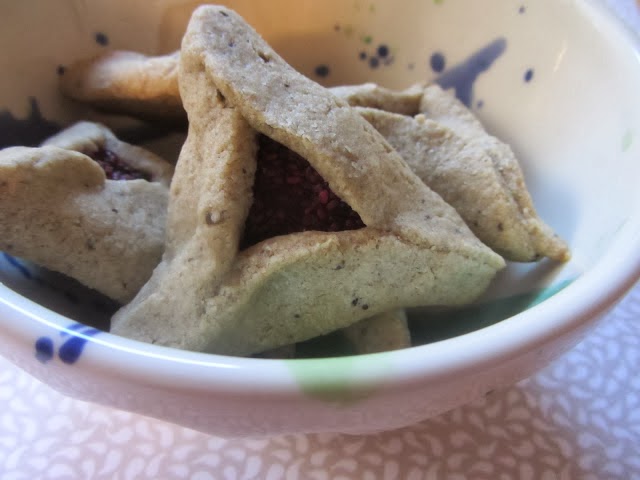
Due to popular demand, after being sold out last year, the Three Tablespoons Hamentaschen Kits are back!

Even if we're still deep into winter freezing our bones, this year, Purim will take place on March 16, so for once, I'm planning ahead!

The updated version allows you to use the kit for making your own hamantaschen, or to gift them as mishloach manot (food gifts, traditional of Purim). Since all the ingredients are pre-measured, all you have to do are the fun parts: mixing, rolling out, cutting, filling and baking with no mess! A great activity for adults and kids, that honors tradition in a fun, modern way.

The resulting hamantaschen aren't only delicious, but also free of gluten, nuts, eggs, bad fats, loads of sugar or refined flours. The filling is made with organic berries, a touch of pure maple syrup and is charged with chia superfood. 

Plus, the kit is an activity set as well. While dough chills and cookies bake, the kits come with everything you need (child and adult friendly) to decorate the box for a beautiful and creative mishloach manot.


Each Kit Contains:
- Dry cookie mix (premeasured)
- Pure maple syrup (premeasured)
- Olive oil (premeasured)
- Cookie cutter
- Berry-chia seed filling
- Mini chocolate chips

- 1 fruit
- Decoration materials
- Baking instructions


Price: $35.00* per kit that makes about 2 dozen cookies


*Delivery and shipping fees may apply 

Please place your order by February 23, 2014
email me at ale@threetablespoons.com 


Monday, December 30, 2013

What it was and what it will be...

I can't believe it's that time of the year again! Last January I wrote here about my thoughts, predictions and hopes for the health food trends of 2013. I was just re-reading,  and I must admit, I was pretty much on the money...Here are my reflections of the past year and what I think is coming ahead:

1. If the theory of Evolution is right, the newer generations will not grow teeth. We're not chewing any more!!! Between the Vitamixes and all the other power blenders of the world, the smoothie and juice joints and services, the ubiquitous frozen yogurt places,* the fancy nut and seed butters, and all those squeezable pureed foods that started for babies and now make products for every age, we can seriously let go of our pearly whites. Why don't we want to chew any more? Is this the New Fast Food? What do you think?

Displaying photo.JPG  
*According to my observation-based pseudo scientific research, there are now more froyo stores in Manhattan than nail salons, and that's a pretty shocking stat!!!

2. Sorry, but not only gluten is out, but grains (and sugar...duhhhh) in general are being blamed for causing a lot of disease. In his best selling book Grain Brain: The Surprising Truth about Wheat, Carbs, and Sugar--Your Brain's Silent Killers, neurologist David Perlmutter, MD holds grains responsible for a lot of our current scariest diseases such as dementia, ADHD, anxiety, chronic headaches, depression, etc. Just add this to the highly popular Primal/Paleo diet and digestive SCD and GAPS protocols, and the picture isn't looking that bright for whole grains.This means good news for nuts and seeds used ground as flour substitutes, and I foresee an abuse on those too until they are blamed for something else. I'm not ready to bid farewell completely to my whole grains yet, but if I owned Kellogg's stock, I would sell (although I should keep at food/nutrition advice and avoid financial ones that I don't really understand).

Grain Brain: The Surprising Truth about Wheat, Carbs, and Sugar—Your Brain's Silent Killers


3. The "it" cuisines are from the South. All the way down to the Andes and the Amazon (the region, not the estore, although I'm sure that's where you can purchase the majority of the ingredients). Peru is the place to go and to purchase from. It started with quinoa, but it hasn't stopped there. Inca superfoods like maca, lucuma and camu-camu and the sweetener yacon are going to keep making their way into our hearts (via smoothies), and I'm betting on kaniwa to become the newest it grain (which is actually a seed). I just hope we get to do it through fair trading and the locals getting something worth in exchange, as we've already taken all their quinoa...According to Vogue, "the latest detox vacations are taking place not only off the beaten track but well above it," with high altitude treks on the Inca Trail. The other place whose ingredients we'll keep getting to know is Brazil. This huge country (which is actually hosting back to back the World Cup and the Olympics, so we'll be learning a lot about it via the media) has unbelievable produce, many with incredible nutritional value that has only been started to get promoted in these latitudes. We already know about acai, but I believe produce with rhythmic names like umbu (high in disease preventing polyphenols), pitanga (with suggested anticancer and anti inflammatory properties), caju and many others, will eventually make it into the American market, labeled as superfoods. Award winning chef, Alex Atala recently published D.O.M.: Rediscovering Brazilian Ingredients, a beautiful coffee table book with foods you didn't even know existed. It's a wonderful eye candy (I wouldn't even dream attempting any of the recipes) and introduction into the exotic foods of Brazil.  
Image from D.O.M.: Rediscovering Brazilian Ingredients (caju)


4. The "it" sweetener is now yacon syrup, which is extracted from the yacon tuber from...Where else? Peru. I had been wanting to write about it for many months, but Dr. Oz had it on his show before I got to do my post, and by highlighting some weight-loss properties from the sweetener, the already hard-to-find syrup, completely vanished from the shelves and the web (unless you're willing to pay like $40.00 plus shipping for a minuscule amount). Yacon is low glycemic, tastes like a cross between molasses and maple syrup, has 50% less calories than sugar, and it's highly concentrated in inulin--a type of fiber that breaks down into fructooligosaccharides (FOS), which are prebiotics (feed the good gut bacteria). Yacon contains potassium, calcium, phosphorous, iron and some amino acids. Just a warning (if you are ever able to get a hold of it): that same wonderful inulin, is also present in Jerusalem artichokes (which I love), and if you've ever had those, you might have realized that they can make you really gassy. So no yacon syrup before a business meeting or a first date! 
 

5. Cultured foods--My most fave topic, so I'll try to keep it short. For a longer spiel, read here. Although there's much more research to be done ahead, keeping out gut microorganisms happy and abundant is essential for good health, not only digestive, but general health, from brain to skin. Small pickling shops have been popping up everywhere in Manhattan, and that is a fabulous trend. When purchasing sauerkraut, kimchi, kvass, or any other pickled vegetables, look for unpasteurized ones that have no vinegar (both kill those bacteria that we need to eat/drink) and no preservatives nor other artificial additives. Dairy kefir and water kefir have been increasing in the market as well, which is excellent news (especially for my son, whose main source of food is kefir). However, my strongest bet goes to COYO. What? You might ask...It stands for coconut yogurt. Made by pureeing (again, the trend I listed under 1.) the meat and water of fresh coconuts and then culturing the blend with yogurt or kefir cultures (microorganisms), slightly sweetened and some times even flavored, I expect to start seeing it EVERYWHERE within the next year. 
Young Coconut Yogurt
Recipe and image from: http://www.rawfoodrecipes.com/recipes/young-coconut-yogurt.html


6. Despite Mayor Bloomberg's efforts to forbid the sale of gigantically-huge-humongous sweetened drinks--that are undeniably bad for anyone--the industry seems to be getting it its way. But not without a fight. I applaud The New York City Health Department's TV and subways placard ad campaign against soda, sports drinks, teas and energy drinks.It's just so easy to inadvertently gulp down huge amounts of sugar without even noticing. I'm glad they are trying to educate people about it! 
http://www.crainsnewyork.com/apps/pbcsi.dll/storyimage/CN/20100802/FREE/100809973/AR/0/soda-ad.jpg?q=100

7. BPA-free canning. Eden organic has been doing it for a while with their beans, but other food companies such as Crown Prince Natural (canned wild fish) and Farmer's Market (vegetable purees) are joining in lining their cans BPA-free. What is BPA? Short for bisphenol A is an industrial chemical used to make certain plastics and resins since the 1960s. BPA is found in polycarbonate plastic containers (often used for storing food and beverages) and epoxy resins are used to coat the inside of metal products, such as food cans, bottle tops and water supply lines.Research has shown that BPA can seep into food or beverages. Exposure to BPA is a concern due to possible health effects on the brain, behavior and prostate gland of fetuses, infants and children and fertility issues in adults.Therefore, it's a good thing that if you consume canned products and/or use plastic containers, that you purchase the ones labled BPA-free.


8. It's been a juicy year for celebrity chef scandals. I guess it all comes with the territory, however, I do  hope Nigella Lawson goes to rehab, puts her personal and professional lives back together and keeps showing up on TV and writing wonderful cookbooks that turn recipes into experiences I want to go through. I can't help it, ever since How To Be A Domestic Goddess many years ago, I've been a big fan. 

9. "Healthy Eating" is IN and vegetables are cool. The once-blah-now-superhip Bon Appetit magazine has done a great job promoting them. 
food lovers cleanse main
Photo by Carin Olsson for Bon Appetit


10. Here, here and here are some lists of the best cookbooks of 2013. However, the ones I personally used the most are:
-Gwyneth's It's All Good
-Kim Kushner's The Modern Menu
-Yotam Ottolenghi and Sami Tamimi's Ottolenghi: The Cookbook (although this book was a re-launch not really a 2013 release) 
- Estee Kafra's Cooking Inspired


NUT/SEED MYLK 

 I keep getting requests on how to make nut and seed mylks such as almond, hemp, cashew, etc. You can basically turn any seed or nut, even coconut (either dry or fresh young)--although not chia seed-- into "mylk" by pureeing it with water, and passing the mixture through a sieve. You can flavor it with spices and sweeten it (I like making mine with dates). By making your own mylk, you avoid any harmful additives such as carrageenan, and others that are common in most milk alternatives. There are endless possibilities, my favorite proportions are:

Ingredients
2 cups organic raw nuts (almonds, cashews, walnuts, Brazil, macadamia, hazelnuts, unsweetened shredded coconut, etc) or seeds (pumpkin, hemp, sunflower seeds, sesame, etc)
4 cups water (plus more for soaking the nuts and rehydrating dates)
10 pitted dates (or raw honey, yacon or pure maple syrup or coconut nectar)
1 vanilla bean (or 2 teaspoons pure vanilla extract, but I recommend the bean)
1/8 teaspoon sea salt

Optional: mesquite flour, ground cinnamon, cardamom, allspice, ground ginger

Method
  • Place the nuts/seeds in a container and cover them with fresh water by 2 inches. Cover and refrigerate overnight. If using cashews, soak between 2 and 4 hours. In a separate container, soak dates in water overnight.
  • Drain nuts and dates and rinse them in fresh water. 
  • Place nuts, dates and 4 cups fresh water in a blender and blend until smooth. Time will depends on your blender.
  • Split the vanilla bean lengthwise and scrape the seeds with the back of a knife into the nut/seed-water mixture. Add salt and spices, if using, and blend again.
  • Set a large bowl with a fine mesh strainer/sieve on top* and pour the blended liquid into the strainer, pressing with the back of a spoon to extract more liquid. 
                              
*If you want a completely smooth mylk, line the strainer with cheese cloth.


  • Voila! Refrigerate and enjoy!

Tuesday, December 10, 2013

Sea Veggies:

You have to live under a rock not to notice the invasion of sea vegetable snacks of the past couple of years. They come nicely packaged, and moms allover are thrilled to feed them to their children en lieu of potato chips and other crunchy, uber-processed snacks. 


I will first disclose that I've never purchased any, as none of the brands are kosher certified --the only explanation I found for the need of certification in sea vegetables, is that some times, the seaweed sheets can have tiny parts of sea horses pressed into them--but I'm sure a kosher manufacturer is looking into it in China as I write. However, I do feed seaweed snacks to my kids. I just make them myself at home, and I'm happy to keep preparing them, as I know exactly what goes into the treat (and they only take minutes).

Let's first talk a bit about seaweed, algae or sea vegetables. The foremost thing to keep in mind is that you should buy them in organic form--or at least know their place of origin--as you've probably heard  how polluted with heavy metals our oceans are, and that's exactly where sea vegetables grow. Organic certification ensures that the sea vegetable is either "farmed" in a closely-monitored, contained water environment; or that it's harvested in the wild, but in a region where the water is better protected against pollutants. 

Now...why on Earth would you want to eat algae? 

Well, they have the richest concentration of minerals of anything that's edible, as they absorb all the ones present in the ocean. They also have a great variety of phytochemicals, and a special kind--called fucoidans--that's unique to them and has anti-inflammatory, anti-viral, and cardiovascular benefits; they also contain other unique types of antioxidants. They are an excellent source of iodine (therefore they are good for our thyroid) and vitamin K. They are a good source of some B vitamins, magnesium, iron, calcium, vitamin C (which is a perfect pairing with its iron content for digestibility) and E. 
Some seaweeds are also very rich in Omega 3 fatty acids (that's where fish get them from!). Sea vegetables also contain vanadium, which may play an important role in blood glucose regulation. Sea vegetables also have cholesterol-lowering effects, and this may play a role in decreasing the risk for some estrogen-related cancers (such as breast cancer). Besides thyroid benefits, it's been suggested that sea vegetables are good for our immune system, and our adrenal glands.
Some sources indicate that sea vegetables help our bodies detoxify from heavy metals, environmental pollutants and carcinogenic substances (although more research is needed in this area).

Culinary speaking, sea vegetables are a typical ingredient in Asian cuisines, especially Japanese. However, they've been consumed by most societies in coastal areas, from New Zealand, to South America, to Ireland. They have a rich umami flavor, which can make them a great ally in the kitchen to add some "deliciousness" to dishes, and which may explain why we love sea weed chips, sushi and miso soup so much!
Seaweed is classified into categories by color, and that's how we get brown, red or green algae.

The following are my favorite (and easier to find at health food stores and online, with kosher certification) kinds of sea vegetables:


-  Nori: this is the one in sushi. It's sold as squares (although it doesn't grow like that. It's a mixture of red seaweeds that are pressed together and dried). You can find it toasted (dark green) or untoasted (almost black), and you'd need to toast it before using it: 6 to 7 minutes in a 350 F preheated oven does the trick. You can use it to wrap virtually any food. The untoasted one is the right one for making chips, and you will season the nori before toasting it. 

- Kombu: A brown algae that's great for making soup. It imparts its umami flavor and releases many minerals into the stock. Throw a piece of dried kombu into the pot when cooking beans or chickpeas or other hard-to-digest vegetables, as kombu makes them more digestable. You can remove it after 20 minutes and the food will be infused with flavor, minerals and its nutrients will be more available to you body. 

-Wakame:  It looks a bit similar to kombu, and it's one of the highest sources of vegetarian omega-3s.If you've ever had miso soup, the green leaves floating in it along with the tofu are wakame. To prepare it, soak it in cold water for 5 minutes. Remove, slice (removing tough stems, if any) and add it into soups, stews, or grains. It goes really well with citrus and acid, in general. Wakame can be roasted until brown and crispy and can be used crumbled as a seasoning, the way you'd use salt.

-Arame: Also a brown algae. It has a mild flavor (therefore a great one to start if you've never had seaweed) and is usually sold as strands. You can just soak it in cold water for 5 minutes, drain and throw it into salads, saute with vegetables or cook it along in soups after soaking. Boil it for 10 minutes and add it to marinated dishes.

SEA WEED SNAX

Ingredients

-Nori sheets (as many as you need), not toasted

-Expeller pressed olive, coconut or grape seed oil spray (or oil and a pastry brush) OR
honey, coconut nectar or maple syrup dissolved in water, so they are not as sticky

Toppings: fine sea salt, spices, nutritional yeast, dry herbs, unsweeted coconut shreds, sesame, chia, hemp, poppy seeds, citrus zest, honey, coconut nectar or maple syrup (dissolved in water)

Method
1. Preheat oven to 350 F. Line a (or 2) rimmed baking sheet with parchment paper. 

2. Place as many nori sheets as you can fit in one layer on the baking sheet(s). Lightly* spray (or brush) nori on one side with oil or dissolved liquid sweetener.

3. Sprinkle with topping and bake for 6 to 7 minutes, until nori changes from black to dark green. Cool and enjoy.

*Lightly is the key word. You don't want it soggy.


Some suggested combinations:
-Olive oil + nutritional yeast + chipotle powder or smoked paprika
-Coconut nectar + coconut shreds+ sea salt + hemp seeds
-Olive oil + sumac + garlic powder + lemon zest


Thursday, November 14, 2013

Lime-Avocado Mousse with Bee Pollen Sprinkles

I really shouldn't be doing this right now. I need to work on a project with a very tight deadline. However, this was very delicious and wanted to document and share it.

I been making this mousse as a cupcake topping for a client who follows the SCD protocol. It's also Paleo and GAPS friendly. It's dairy, egg and gluten free, but not considered vegan because it contains honey and bee pollen.
I get both, my raw honey and my bee pollen from Andrew, the bee keeper with a stand in the Union Square Farmer's Market. This way I can make sure they are local and carefully produced.
Please note that if you suffer from pollen or bee allergies, you should leave out the bee pollen in the recipe. But if you are in the clear, bee pollen is an incredible superfood. It's rich in zinc, which is an essential mineral for our immune system. It also contains calcium, iron and potassium and all B vitamins (with the sole exception of B12), it has enzymes, increases stamina, and....Guess what? It's one of the richest sources of complete protein (contains all essential amino acids) on the planet and it's in a highly digestible form. For a bit more on pollen go here.

Now to recipe, and back to work...

LIME-AVOCADO MOUSSE WITH BEE POLLEN SPRINKLES 


Ingredients

1/3 cup raw cashew nuts, soaked overnight, rinsed and drained
2 small avocados, flesh only
1/4 cup raw honey
3 lime, juices and zest of 1 lime
1/4 teaspoon sea salt
2 tablespoons bee pollen 

Method
Grind the cashews in a power blender (I use a Ninja 100Wts). Add the avocados and blend again until light and creamy. Add honey, lime juice and zest and salt. Blend again and season to taste. You might need more salt, or honey, depending on your preferences.

Divide the mousse among 5 serving bowls, jars or glasses. Sprinkle tops with pollen right before serving. 

Mousse keeps well (and still green) for up to 2 days, covered airtight and refrigerated. It even freezes well (without the pollen)